Views: 0 Author: Site Editor Publish Time: 2026-07-24 Origin: Site
Image Source: pexels
Ship designers study heavy loads and hull bends. They also look at building needs. They use special marine aluminum. Marine engineers balance material choices. They pick Aluminum for Shipbuilding when designing trading ships.
The 5083 aluminum is very strong. It works well for heavy boat parts.
The 5086 aluminum bends very easily. It helps workers make complex shapes.
Shipyards pick the best metal. They consider how long boats last. They think about rough weather. This saves money and works well.
Grade 5083 aluminum gives top strength.
It works for heavy boat hulls.
It also supports deep ship frames.
Grade 5086 aluminum bends very easily.
It forms smooth shapes for cabins.
It will not crack or break.
Special H116 and H321 tempers help.
They protect marine aluminum from ocean rust.
Saltwater cannot damage it as easily.
Mixing both aluminum grades saves money.
It reduces total ship weight too.
Ships then get much better performance.
Ship designers study metals before building new boats. They review 5086 vs 5083 aluminum options. This helps them balance strength and workability. Both metals use magnesium as their main metal. They belong to the 5000 series aluminum group. These alloys cannot be heat-treated.
Shipbuilders study metal traits to place parts correctly. Grade 5083 offers high tensile and yield strength. It works best for key structural parts. Grade 5086 has lower overall strength. Yet, it bends easily without breaking.
This table shows key features and main uses:
Mechanical Property / Feature | 5083-H116 Alloy | 5086-H116 Alloy | Relative Performance Difference | Typical Shipyard Application |
|---|---|---|---|---|
Ultimate Tensile Strength | 317 MPa (46 ksi) | 290 MPa (42 ksi) | 5083-H116 is 9% higher | Stressed hull plates and bulkheads |
Tensile Yield Strength | 228 MPa (33 ksi) | 207 MPa (30 ksi) | 5083-H116 is 10% higher | Heavy frames and strong bows |
Elongation at Break | 12% - 16% | 14% - 18% | 5086-H116 bends more easily | Curved cabin tops and decks |
Engineering Tip: Strong waves need high yield strength. Curved hull shapes need high stretch limits.
Grade 5083 gets its strength from magnesium mixing. It does not use heat treatment processes. This smart metal mix stops ocean water rust. Welded joints stay strong and safe. That makes 5083 aluminum great for welded hulls.
Magnesium Content & Peak Strength: Grade 5083 has about 4.5% magnesium. This makes it a very strong option. It is stronger than other non-treated metals.
Dynamic Load Endurance: Big waves slam into ship hulls. This alloy stops cracks from sudden shocks.
Marine Class Regulations: Sea agencies like ABS set clear rules. Builders use H116 and H321 tempers. These tempers stop ocean rust on metal.
Heavy boat hulls need strong metal plates. Upper ship parts need more flexibility. Grade 5086 forms well during cold bending. Shipyards use this marine aluminum to save money. They build complex cabin shapes without cracking metal.
Boat builders study metal mix details. Elements change how metal acts in water.
The metal 5083 aluminum is strong. High magnesium boosts inner strength. This stops atomic shifts easily. It keeps metal tough at low cold levels.
Chemical Element | Mass Fraction Range (%) |
|---|---|
Magnesium (Mg) | 4.0 – 4.9 |
Manganese (Mn) | 0.4 – 1.0 |
Chromium (Cr) | 0.05 – 0.25 |
Iron (Fe) | ≤ 0.4 |
Silicon (Si) | ≤ 0.4 |
Copper (Cu) | ≤ 0.1 |
Zinc (Zn) | ≤ 0.25 |
Aluminum (Al) | Remainder |
⚠️ Technical Note: High magnesium raises metal power. Yet, too much forms bad tiny bits. Workers must watch hot weld heat carefully.
Builders pick 5086 aluminum for bent parts. Lower magnesium makes shaping easy. Builders bend sheet metal without snaps.
Superior Formability: Workers easily shape cold metal boat parts.
High Crack Resistance: Strong metal stops wave damage quickly.
Temper codes show real metal strength. Builders pick good tempers for ocean safety.
H116 Temper: Hard strain steps stop metal decay.
H321 Temper: Heat fixes metal after cold steps.
H32 Temper: Strain steps give good stiff deck parts.
This special metal protects big boat hulls.
Image Source: unsplash
Aluminum alloys protect sea ships well. Engineers pick these metals for safety. They want boats to last long. Special metals form quick oxide skins. This skin stops fast saltwater rust. It protects big boat frames.
Boat hulls must stay very tough. Deep water has salt and weeds. Aluminum fights tiny surface rust holes. It beats standard carbon steel easily. Good metals stay strong in deep seas. They offer top ocean protection.
Maintenance Insight: Oxide layers fix themselves very fast. Fresh air helps metal heal quickly.
Boat designers test metal in labs. Tests check metal cracks and rust. Labs test metals before ship building.
Testing Standard | Target Corrosion Evaluation | Test Methodology Description |
|---|---|---|
ASTM G66 (ASSET) | Exfoliation Corrosion | Check sample looks after hot bath. |
ASTM G67 (NAMLT) | Intergranular Corrosion (IGC) | Check weight loss in acid bath. |
ASTM G129 (SSRT) | Stress Corrosion Cracking (SCC) | Pull metal slow in bad air. |
The ASTM G66 test uses hot chemical water. Metal sits for 24 full hours. Workers check pictures to grade rust resistance.
Metal tempers boost overall rust control.
H116 Temper: Cold rolling steps make metal hard. It stops tiny inner metal rust.
H321 Temper: Gentle heat treats cold metal sheets. This heat spreads tiny particles evenly. It stops bad surface rust well.
The H321 heat step stops metal changes later. Metal stays safe for a long time. The H32 temper keeps upper decks strong. It brings great ocean rust protection.
Shipyards use aluminum for shipbuilding to build ships. Weld heat weakens metal near joints. Engineers call this soft spot the heat-affected zone. Builders use filler wires 5183, 5356, and 5556. They weld heavy plates with these wires. Filler metals fix joint strength on panels.
Fabrication Tip: Techs control heat to keep welds very strong.
Workers bend raw alloy sheets into curved panels. Lower magnesium in 5086 aluminum aids bending. This metal bends without tiny cracks at sea. So, curved boat hulls stay very tough.
Heat bends metal during every weld job. Techs clamp alloy plates with hydraulic tools. Special tools trim plate edges before welding. Good weld steps spread heat across structures. Thermal care keeps aluminum for shipbuilding straight.
Image Source: pexels
Boat builders choose metal based on stress levels. Modern shipyards combine metals for lightweight ships. Designers place 5083 aluminum and 5086 aluminum smart.
Ship bottoms fight strong ocean waves daily. Engineers select tough metals for hull plating. The strength of 5083 aluminum helps keels. It protects engine girders from deep sea pressure.
Architects need shock control for ship structures. Working boats face harsh docks and low water. Builders use aluminum for shipbuilding for hulls. Thick plates stop deep bends in bad seas. Engineers save weight compared to heavy steel.
Upper decks need soft metal that bends well. Builders choose 5086 aluminum for cabins. This metal shapes easily without breaking once. Workers build curved surfaces with simple tools.
Design Tip: Flexible metals on decks lower top weight. This keeps ships steady in rough water.
Deck builds need flat tops and good joints. Engineers use aluminum for shipbuilding for decks. Luxury ships use aluminum for shipbuilding for finishes. Workers weld plates without bending surface frames. Lighter tops lower the ship center point.
Designers mix metals to save building money. They use different alloys across ship zones.
Vessel Zone | Preferred Alloy Grade | Key Engineering Reason | Typical Application |
|---|---|---|---|
Lower Hull Frame | Grade 5083-H116 | High yield strength and impact resistance | Bottom plating and keels |
Deck Surfaces | Grade 5083 / Grade 5086 | Load support and flat surface stability | Main cargo and passenger decks |
Complex Cabins | Grade 5086-H116 | High ductility and cold bending ability | Wheelhouses and curved tops |
Internal Bulkheads | Grade 5086-H32 | Cost savings and low structural load | Watertight compartment walls |
Smart metal choices lower total project costs. Shipyards save labor time with soft metal.
Strategic Thickness Selection: Engineers put 5083 aluminum plates below water.
Simplified Fabrication: Workers shape 5086 aluminum sheets for cabins.
Weight Optimization: Light tops allow bigger ship cargo loads.
Builders use aluminum for shipbuilding on decks. Workers fit 5086 aluminum on cabin walls. Operators use aluminum for shipbuilding for longevity. Smart metal mixes save valuable boat fuel. Good choices keep ships active for years.
Ship designers check metal prices carefully. They study total building costs. Smart metal choices balance raw plate prices. Good choices lower workshop labor costs.
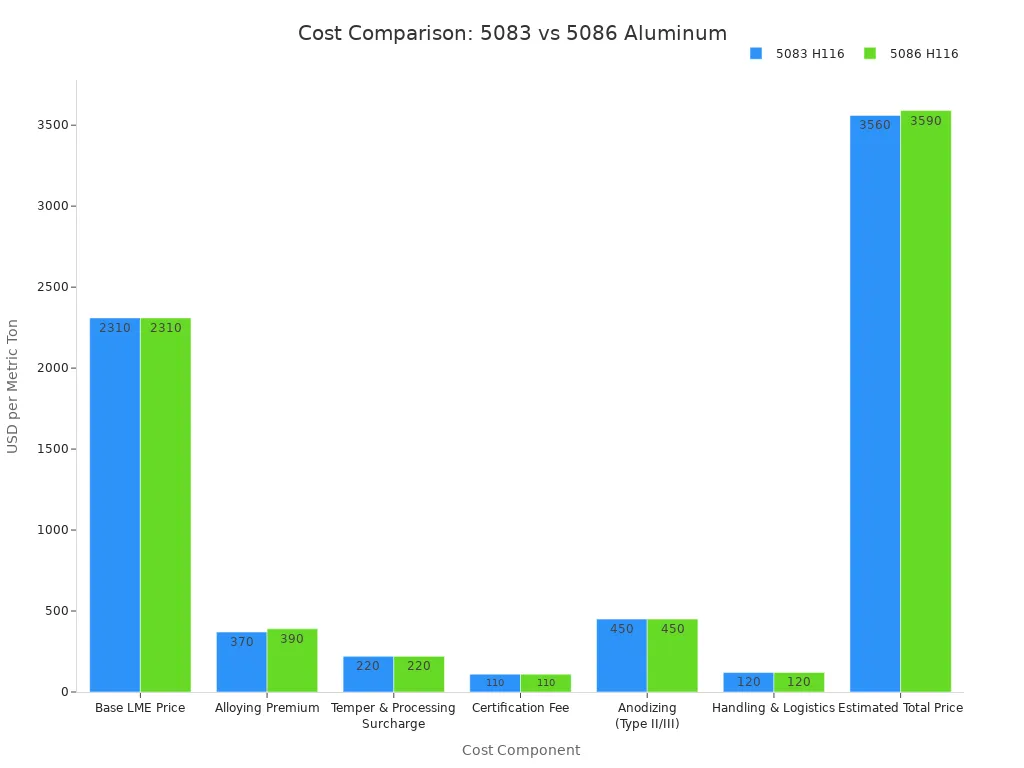
Buy prices vary across marine alloys. Grade 5086 H116 costs $3,590 per ton. Grade 5083 H116 costs $3,560 per ton. The gap is $30 per ton. High magnesium content drives this gap.
Cost Component | 5083 H116 (USD/ton) | 5086 H116 (USD/ton) |
|---|---|---|
Base LME Price | $2,310 | $2,310 |
Alloying Premium | $370 | $390 |
Temper & Processing Surcharge | $220 | $220 |
Certification Fee | $110 | $110 |
Anodizing (Type II/III) | $450 | $450 |
Handling & Logistics | $120 | $120 |
Estimated Total Price | $3,560 | $3,590 |
Shipyards recover extra plate costs later. Easy metal shaping saves shop tools. Soft metals bend much faster.
Financial Insight: Easy bending cuts shop labor hours. Savings balance higher raw metal prices.
Engineers match alloys to vessel zones. Each area needs proper strength. Parts also need good flexibility.
Submerged Bottom Hulls: Grade 5083 gives peak strength. It stops wave impact damage.
Complex Wheelhouses: Grade 5086 shapes easily. Metal will not crack.
Internal Structural Frames: Grade 5086 saves build money. It suits low-stress internal walls.
Designers pick metals to lower costs. Good placement keeps hulls very strong. Work time stays low.
Naval architects pick ocean metals for boats.
Strong 5083 aluminum plates protect deep hulls. They offer great strength against water pressure.
Soft 5086 aluminum sheets bend easily. Workers shape curved tops and inside frames.
Mixing both metals saves ship money. It makes the boat very light.
Engineers select certified H116 or H321 tempers. These tempers stop ocean rust well. They meet tough sea safety rules.
Smart choices make aluminum for shipbuilding last long.
Boat designers choose 5083 aluminum for hulls. This metal has very high strength. Added magnesium stops wave damage well. It protects deep ship bottoms from rust. It keeps critical parts safe under pressure.
Builders pick 5086 aluminum for bent parts. Lower magnesium makes the metal soft. Workers shape curved cabin tops easily. This metal shapes well without snapping. It works great for inside ship walls.
Engineers select H116 and H321 tempers. These tempers fight harsh ocean rust. The H116 temper stops tiny surface rot. The H321 temper uses gentle heat steps. This keeps magnesium particles stable for years.
Workers often weld both metals together. They use 5183 or 5356 wires. These wires keep welded joints strong. Good heat control stops plate bends. This step keeps whole ships very safe.