



| Quantity: | |
|---|---|
Aerospace aluminium is an ultra-high strength wrought aluminium alloy, and aerospace aluminium profiles generally refer to 7-series aluminium alloy profiles. 7-series aluminium alloys have the highest hardness among all aluminium alloys and are currently widely used in the aerospace industry. Compared with ordinary aluminium alloys, aluminium alloys used in aircraft have higher requirements for strength, hardness, toughness, fatigue resistance, and plasticity. Aerospace aluminium alloys have good mechanical and processing properties, good plasticity after solution treatment, and good heat treatment strengthening effect, generally maintaining high strength below 150℃ (or even higher); they also have good toughness, making them ideal aerospace structural materials; and they utilize cold-treated forged alloys, resulting in high strength.
Different aircraft components place very different demands on aluminium plate. Rather than relying on a single alloy, HSHALUC offers multiple grades and tempers to match structural strength, forming requirements, corrosion conditions and machining needs.
Alloy / Temper | Dimensions | Typical Mechanical Properties | Certifications | Applications |
|---|---|---|---|---|
2024-O | Thickness: 1–177 mm; Width: 950–1800 mm; Length: 2000–6000 mm | Tensile Strength ≤220 MPa; Yield Strength ≈95–100 MPa; Elongation ≥12% | GB/T 19001-2016 / ISO 9001:2015 | Deep-drawn parts, complex formed parts |
2024-T3 | Tensile Strength ≈430–450 MPa; Yield Strength ≈275–290 MPa; Elongation 10–20% | Fuselage skin, wing skin | ||
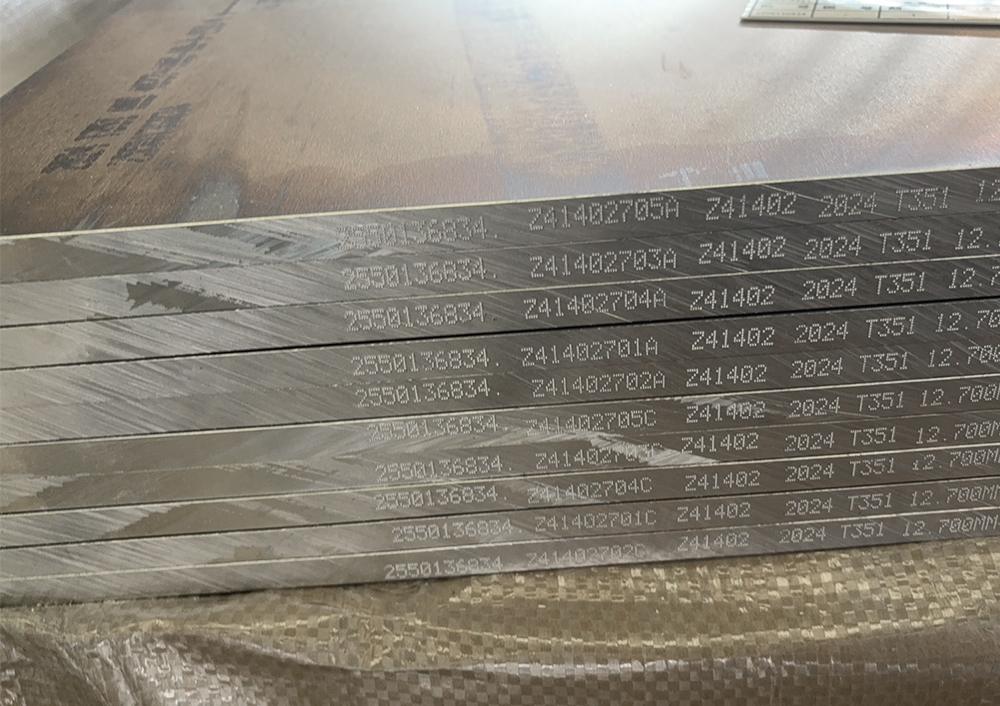
2024-T351 | Tensile Strength ≈430–495 MPa; Yield Strength ≈290–340 MPa; Elongation 8–21% | Fuselage frames, wing ribs, thick plate components | ||
2124-T854 | Tensile Strength ≈450–500 MPa; Yield Strength ≈380–430 MPa; Elongation 6–10% | Large fuselage structures, wing spars | ||
5754-H111 | Tensile Strength ≈190–220 MPa; Yield Strength ≈80–100 MPa; Elongation 15–25% | Aircraft interiors, cabins, non-load-bearing components | ||
6013-T4 | Tensile Strength ≈280–320 MPa; Yield Strength ≈150–190 MPa; Elongation 15–20% | Aircraft skin, fuselage structures | ||
6061-T651 | Tensile Strength ≈290–320 MPa; Yield Strength ≈240–275 MPa; Elongation 8–12% | Frames, brackets, bulkheads | ||
6063-O | Tensile Strength ≈120–150 MPa; Yield Strength ≈45–70 MPa; Elongation 20–30% | Aircraft interiors, complex formed parts | ||
6082-T6 | Tensile Strength ≈290–340 MPa; Yield Strength ≈240–300 MPa; Elongation 8–12% | Aviation ground equipment, structural components | ||
7050-T7451 | Tensile Strength ≈510–540 MPa; Yield Strength ≈455–485 MPa; Elongation 9–12% | Fuselage frames, wing spars, bulkheads | ||
7075-O | Tensile Strength ≈220–280 MPa; Yield Strength ≈100–150 MPa; Elongation 12–20% | Preformed aerospace structural components | ||
7075-T6 | Tensile Strength ≈560–575 MPa; Yield Strength ≈500 MPa; Elongation 8–12% | Wing spars, wing ribs, load-bearing frames | ||
7075-T651 | Tensile Strength ≈530–570 MPa; Yield Strength ≈470–505 MPa; Elongation 8–11% | CNC-machined aerospace structural parts, thick plate components | ||
7075-T7351 | Tensile Strength ≈470–510 MPa; Yield Strength ≈400–435 MPa; Elongation 9–13% | Long-life fuselage structures, wing spars | ||
7175-T7351 | Tensile Strength ≈500–570 MPa; Yield Strength ≈440–500 MPa; Elongation 7–11% | Highly stressed aircraft structures, wing spars | ||
7475-T7351 | Tensile Strength ≈450–500 MPa; Yield Strength ≈365–420 MPa; Elongation 8–12% | Wing skin, fuselage skin |
Belonging to the Al-Zn-Mg-Cu alloy series, it is renowned for its excellent strength, outstanding resistance to stress corrosion cracking, and good toughness.
2.1 Zinc: Content approximately 5.0-8.5%. It is the most important and strongest strengthening element in the 7-series alloys. Together with magnesium and copper, it forms highly effective strengthening phases such as MgZn₂ (η and T phases).
2.2 Magnesium: Content approximately 1.5-2.8%. Working synergistically with zinc, it is key to achieving ultra-high strength.
2.3 Copper: Content approximately 1.0-2.5%. Besides its own strengthening effect, it significantly improves the stress corrosion cracking resistance and hardenability of the 7-series alloys.
2.4 Zrconium: Content approximately 0.05-0.15%. It replaces chromium in early 7-series alloys. It forms dispersed Al₃Zr particles, effectively inhibiting recrystallization and refining grains, improving toughness and fatigue resistance.
2.5 Chromium, Manganese, and Titanium: Also commonly used to control grain structure and recrystallization.
The success of the 7-series aerospace aluminium alloys lies not in simply pursuing the ultimate in one performance metric, but in achieving a perfect balance of three key properties: strength, toughness, and corrosion resistance. This satisfies the core requirements of modern aircraft for weight reduction, safety, and long service life.
1. Excellent combination of high strength and high toughness: Compared to the classic 7075 alloy, 7050 maintains high strength while exhibiting superior fracture toughness. This means it better resists crack propagation, improving structural safety and durability.
2. Outstanding resistance to stress corrosion cracking: This is one of the most significant advantages of the 7050 alloy. Its special T7451 over-aging heat treatment state greatly improves its resistance to stress and corrosion in both stress and corrosive environments. Its strong resistance to cracking under stress makes it particularly suitable for long-term use in harsh environments such as the marine atmosphere.
3. Excellent fatigue performance: As an aerospace structural component, it needs to withstand frequent cyclic loads. 7050-T7451 exhibits excellent fatigue resistance, capable of withstanding years of flight takeoffs and landings and airflow impacts.
4. High hardenability: Even in thicker sections (such as thick plates and forgings), this alloy achieves uniform and deep mechanical properties after heat treatment, ensuring the consistency of the overall performance of large structural components.
5. Good machinability: In the annealed state, it is easy to machine, and after forming, it can achieve its final strength through heat treatment, which facilitates the manufacture of parts with complex shapes.
Your Requirement | Alloys / Tempers to Consider |
|---|---|
Complex forming / deep drawing | 2024-O / 6063-O |
Aircraft skin applications | 2024-T3 / 6013-T4 / 7475-T7351 |
High-strength machined components | 7075-T651 / 7050-T7451 |
Wing spars & ribs | 7050-T7451 / 7075-T6 / 7175-T7351 |
Fuselage frames & bulkheads | 7050-T7451 / 7075-T7351 |
General structural brackets & frames | 6061-T651 / 6082-T6 |
Formed non-primary components | 5754-H111 |
High-strength structures requiring improved corrosion resistance | 7050-T7451 / 7075-T7351 / 7175-T7351 |
Send us your application, required mechanical properties, plate dimensions, drawing and applicable material standard. Our team can help narrow down suitable alloy and temper options for your purchasing requirements.
Request Material Recommendation →
"Aerospace Core Structures" This is the most important and critical application area for 7-series aluminium sheets. Their main function is as critical structural components, commonly used in the main load-bearing structures of aircraft, such as wing skin, fuselage frames, stringers, and keel beams, maintaining long-term structural integrity and reliability in harsh environments.
Wing Skin: Bears aerodynamic forces and bending moments during flight, requiring materials with extremely high tensile strength, compressive strength, and fatigue performance. 7050-T7451 is widely used.
Wing Spans and Stringers: As the main load-bearing skeleton of the wing, requiring high strength and good toughness.
Fuselage Frame and Bulkheads: Maintain the fuselage shape and bear various loads.
Fuselage Keel Beams: The core load-bearing structure of the lower fuselage.
Bulkheads and Floor Beams: Provide internal support and strength.
Skin, ribs, and beams of the horizontal and vertical tail fins: Bearing the loads for controlling and stabilizing the aircraft.
Landing gear support components and doors in some aircraft are made of high-strength 7-series aluminium alloy forgings or thick plates.
Used for rocket fuel tanks, interstage sections, and the structural framework of satellites and space stations, utilizing its high specific strength to achieve effective weight reduction.
Send us your required alloy, temper, dimensions, quantity, material standard and drawing. If the alloy has not yet been finalized, tell us the application and required mechanical properties so that suitable material options can be discussed.


