loading



loading
| Availability: | |
|---|---|
| Quantity: | |
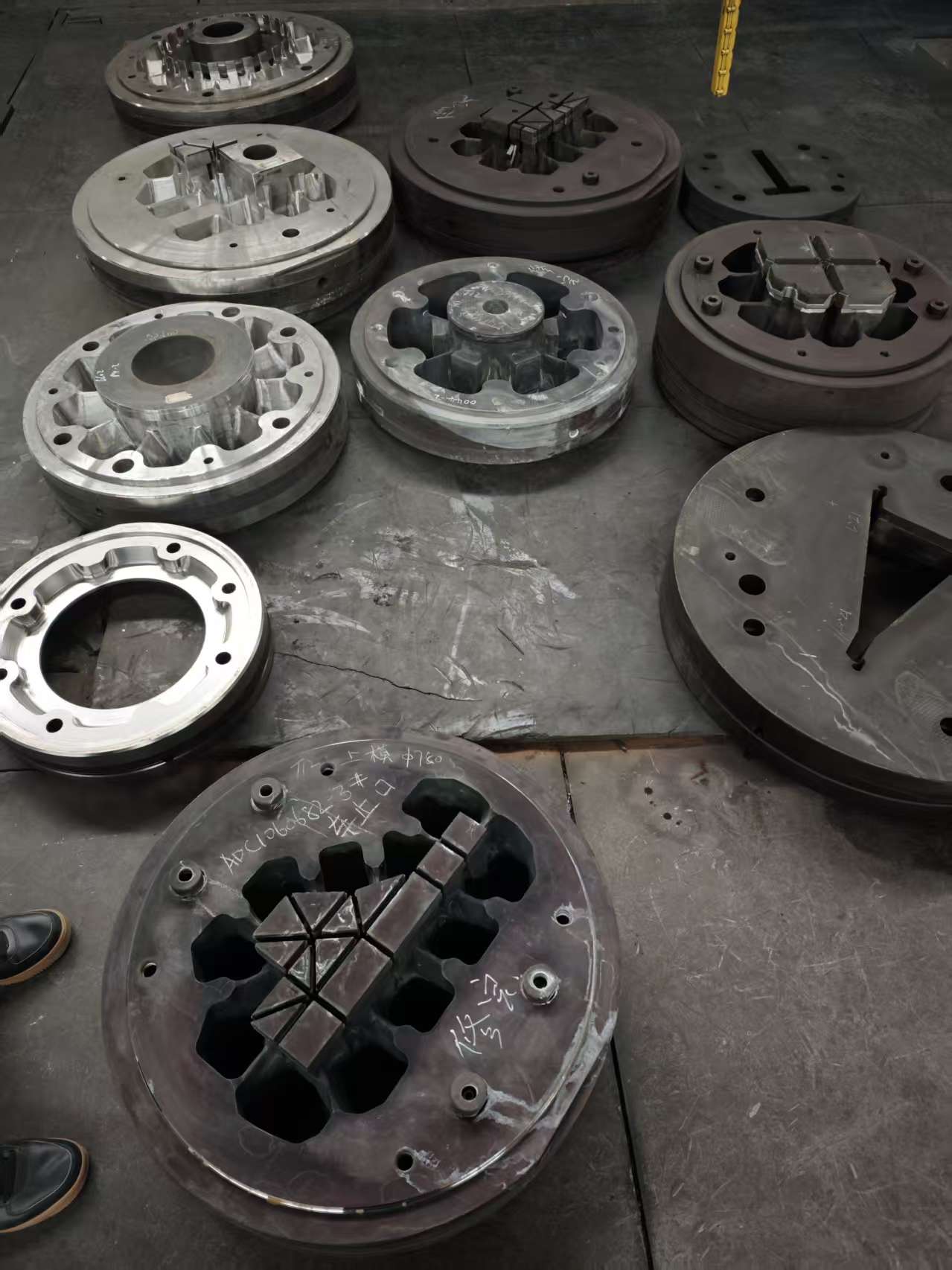
Structural characteristics: The structure is relatively simple, consisting of a mold with a die hole.
Working principle: Aluminum metal flows directly through the die holes without diversion or welding.
Scope of application: For manufacturing solid profiles, including angle aluminum, channel aluminum, I-beam aluminum, round bars, square bars and various industrial solid profiles.
Design points: The precise adjustment of the working length is the key to control the metal flow rate and ensure the straightness of the profile.
Structural characteristics: This is the most complex and technically sophisticated type of die, consisting of an upper die and a lower die.
(Upper die: Equipped with a split bridge and die core (tongue). The split bridge splits the aluminum ingot, while the die core's shape determines the profile's internal cavity configuration.
Lower die: Feature a die hole (working zone) and a welding chamber. The profile of the die hole determines the external shape of the profiled part.)
Working principle: The aluminum alloy is divided into several streams by the shunt bridge→ Enter the welding chamber → Re-welding under high temperature and high pressure → Encapsulated upper die core → Extruded from the lower die hole.
Scope of application: Used for manufacturing hollow profiles, including round and square tubes, as well as industrial profiles with complex cavities (e.g., automotive sunroof guides, radiators).
Design points: The size and position of the vent hole, the shape and depth of the welding chamber, the strength and rigidity of the die core are the core factors that determine the life of the die and the quality of the welding.
The core challenge in extrusion die design lies in achieving uniform metal flow velocity across all die holes. Inconsistent flow velocity may cause the profile to develop waves, twists, bends or even tears. Engineers address this issue through the following approaches:
The working zone is the fixed diameter zone on the die which is perpendicular to the discharge direction. It is the valve to control the metal flow velocity.
Principle: Utilizing friction. Friction is generated when metal flows through the working zone.
Strategy: In areas where metal flows easily (e.g., the center of profiles or thicker sections), extend the working strip to increase friction resistance and reduce flow velocity. In areas where metal flow is difficult (e.g., edges of profiles or thinner cantilever sections), shorten the working strip to decrease resistance and promote flow.
Baffle angle: A reverse slope is installed at the entrance of high-velocity flow to prevent metal from being directly channeled into the flow.
Flow angle: Create a slope in areas with slow flow to facilitate metal entry.
Feeder Hole: The metal quantity of each part of the die core is balanced by adjusting the size, shape and distribution of the feeder holes.
Welding Chamber: The depth and shape of the welding chamber directly affect the welding pressure of aluminum. A deeper welding chamber results in greater hydrostatic pressure, leading to better welding quality, but it also increases the extrusion force.
Modern mold design has become inseparable from numerical simulation. By using software such as Deform, Qform and Altair to simulate the flow of aluminum within molds, designers can predict stress distribution and temperature fields. This allows them to identify and correct potential defects before machining, significantly reducing the number of trial moldings.
3.1 Design and Programming: Perform 3D modeling based on profile drawings, design mold structures, and generate CNC machining programs.
3.2 Coarse machining: On a standard milling machine or machining center, the mold steel (typically H13) undergoes rough machining to remove excess material and reserve space for heat treatment.
3.3 Heat treatment: Vacuum quenching and tempering are performed to achieve the required hardness (typically HRC 48-52) of the mold while ensuring good toughness.
3.4 Finishing Machining: Precision engraving on high-speed machining center to fabricate key components including mold holes, work belts, and diversion holes.
3.5 Electrical Discharge Machining (EDM): This technique is employed for deep narrow grooves and complex irregular holes that are inaccessible to conventional cutting tools.
3.6 Wire-Electrode Cutting: Cutting die mouth, diversion hole and die shape.
3.7 Extrusion Die repair by fitters: This is the most experience-intensive step. The fitter manually polishes and adjusts the workpiece to ensure smooth mold discharge.
3.8 Surface treatment: Nitriding by gas or ion to improve surface hardness and wear resistance, and reduce aluminum adhesion.
3.9 Inspection and extrusion die testing: Perform mold testing on a small extruder to verify the profile dimensions and surface quality. Qualified products are then stored in the warehouse.
4.1 Common failure modes include:
Cracking: Mostly caused by stress concentration or insufficient material toughness, commonly observed at the root of diversion bridges or the sharp corners of formwork holes.
Collapse: The die core undergoes plastic deformation under high pressure, resulting in a reduction in the inner hole size of the profile.
Wear: The working strip is subjected to prolonged erosion by aluminum, resulting in dimensional enlargement and exceeding the permissible wall thickness of the profile.
Aluminum adhesive: The aluminum metal adheres to the working belt, scratching the profile surface.
4.2 Maintenance measures:
Periodic nitriding: After each pressing cycle (e.g., 20-30 tons), re-nitriding is required to restore surface hardness.
Alkali cleaning: Clean the mold with alkaline solution regularly to remove adhered aluminum.
Stress relief: After welding, the stress relief treatment should be carried out.


