Views: 0 Author: Site Editor Publish Time: 2026-07-26 Origin: Site
Image Source: pexels
Picking the right aerospace aluminum plate takes careful thought. First, check your operating load conditions. Then, look at yield strength and fatigue resistance. You must also study environmental risks. Next, find your gauge thickness requirements. Finally, check all official compliance standards.
Metric | Value |
|---|---|
2023 Market Valuation | USD 4.2 Billion |
Projected 2028 Valuation | USD 6.3 Billion |
Forecast Growth Rate (CAGR) | ~5.2% |
Aluminum alloys make up most airplane frames today. They equal eighty percent of total airframe weight. Wise material choices protect your aircraft structure. They keep it safe under extreme physical stress.
Pick 2000 series aluminum to stop metal cracks.
It protects high-tension airplane skins very well.
Choose 7000 series aluminum for strong wings.
It handles very heavy loads easily.
Use T651 temper plates for deep cuts.
This stops the metal from warping bad.
Check metal quality with sound wave tests.
Always read the official paper reports too.
Image Source: pexels
Finding a good aerospace aluminum plate means knowing metals well. Different metal types hold different airplane parts together. You need to pick metals that fit your needs.
The 2000 series resists damage very well. Engineers pick this copper metal for high-pull areas. These parts include bottom bodies and outer wing skins.
The 2024-T3 aluminum grade fights off repeated stress. It keeps small cracks from growing during long flights.
Property Name | Value (Metric) | Value (Imperial) |
|---|---|---|
Ultimate Tensile Strength (UTS) | 480 MPa | 69 × 10⊃3; psi |
Yield Tensile Strength | 320 MPa | 47 × 10⊃3; psi |
Fracture Toughness | 25 MPa·m⊃1;/⊃2; | 22 × 10⊃3; psi·in⊃1;/⊃2; |
This metal rusts a bit more easily. High copper levels cause this quick rusting problem. You can fix this issue using smart protective steps:
Alclad Pure Cladding: Pure metal layers cover the inner core safely.
Anodizing and Primers: Special paints block wet air from touching metal.
Galvanic Isolation: Safe barriers stop damage between different metal types.
This chart shows why 2024-T3 beats 7075-T6 here:
Structural Performance Aspect | 2024-T3 Characteristic | Comparison to 7075-T6 | Advantage for Fuselage Tension Applications |
|---|---|---|---|
Crack Propagation Rate | Slower crack growth | Slower growth once cracks form | Ideal for inspection-managed damage tolerant designs |
Notch Sensitivity | Lower sensitivity | Less notch-sensitive | Reduced risk of catastrophic failure from surface dents/scratches |
Fracture Toughness | Higher toughness | Superior overall toughness | Higher resistance to impact and fracture under tensile stress |
You need zinc metals for maximum heavy loads. The 7000 series works best for heavy parts. These include top wing skins and main support beams.
Standard 7075-T6 high-strength aluminum handles heavy static loads. Yet thicker metal plates need strong inner centers. The 7050 aluminum grade helps solve thick plate problems.
Critical Engineering Criterion | 7075 Alloy Performance | 7050 Alloy Performance |
|---|---|---|
Through-Thickness Strength | Suffers a 10%–15% drop in tensile strength at the core for plates thicker than 3 inches. | Maintains consistent strength throughout the core due to optimized chemistry and quench response. |
Stress Corrosion Cracking (SCC) | High vulnerability to SCC in the short-transverse direction under tensile stress. | Superior SCC resistance, especially in the overaged T7451 temper. |
Thick Section Applications | Prone to significant property gradients and property degradation in heavy gauges. | Developed specifically for thick-section parts (>3 inches) without sacrificing mechanical integrity. |
Look at trade-offs for 7075-T6 and 7050-T7451 here:
Performance Metric | 7075-T6 | 7050-T7451 | Comparative Advantage |
|---|---|---|---|
Yield Strength | 503 MPa | 469 MPa | 7075-T6 provides higher static yield strength |
SCC Threshold (% Yield Stress) | Crack initiation at ~30% | Resistant up to ~75% | 7050-T7451 offers superior corrosion resistance |
Using 7050 plates for thick parts helps greatly:
Enhanced Fracture Toughness: You get great hit protection and high strength.
Extended Fatigue Life: Your metal parts last through many rough flights.
Thermal Resistance: The metal keeps its shape in hot air.
The 6000 series brings strength, rust control, and easy shaping. People use 6061-T6 and 6061-T651 for inside frames. They also build fuel line parts with these metals.
This useful aluminum grade gives strong support light-weight metal:
Property Category | Specific Metric | Measured Value |
|---|---|---|
Mechanical Strength | Tensile Strength | ~310 MPa (45,000 psi) |
Mechanical Strength | Yield Strength | ~276 MPa (40,000 psi) |
Material Density | Mass Density | 2.70 g/cm³ (0.0975 lb/in⊃3;) |
Elasticity | Young's Modulus (E) | 68.9 GPa |
Shear Resistance | Shear Modulus (G) | 26.0 GPa |
Ductility | Elongation at Break (≤6.35 mm thickness) | 8% |
Ductility | Elongation at Break (>6.35 mm thickness) | 10% – 12% |
Toughness | Fracture Toughness (KIC, TL orientation) | 29 MPa·m½ |
Hardness | Brinell Hardness | 95 HB |
The 6061 type works great in hard spots:
Natural Defense Mechanism: It creates a protective skin in open air.
Environmental Durability: It stays strong near wet sea air environments.
Surface Treatment Compatibility: It takes color coatings very well for flight.
Heat treatments change metal strength. They also change toughness and rust risks. Pick the right temper carefully. This helps balance strength and build needs.
Choose T6 temper for high strength. Shops heat 7075 alloy at 450 °C. Next, they cool it fast. Then, they age it at 120 °C. This takes 24 full hours. Tensile strength reaches up to 540 MPa. However, T6 parts crack easier under stress.
Heat Treatment Temper | SCC Susceptibility Level | Characteristics & Performance |
|---|---|---|
T6 Temper (e.g., 7075-T6) | High Susceptibility | Highly prone to stress corrosion cracking, causing potential field failures. |
T73 / T76 Tempers (e.g., 7050-T73) | Superior Resistance | Uses optimized thermal treatments to stop stress corrosion cracking while keeping high strength. |
Fast cooling traps stress in thick plates. Raw T6 plates twist during cutting. Mechanical milling forces cause these shape changes. Pick a stress-relieved T651 aluminum grade instead. This choice stops metal distortion completely.
Machine stretching removes internal stress in four steps:
Controlled Plastic Elongation: Pull the cooled plate slightly past its yield.
Stress Redistribution: Stretching balances all internal tension evenly.
Stress Reduction: This pull cuts internal stress by 80%.
Thermal Stability: Balanced stress stops twisting during deep cuts.
Using T651 plate prevents material warping. It eliminates post-machining spring-back. It protects precise geometry well.
Pick overaged T73 or T76 tempers. They work great in harsh spots. Overaging heats aluminum plates for longer times. This process improves material durability using physical changes:
Long heating widens spaces between grain particles.
Wider gaps break up continuous anodic pathways.
Cut links stop localized corrosion attacks safely.
Choosing T73 drops tensile strength by 10%. You accept this small loss happily. It gives your plane essential cracking protection.
Match your aerospace aluminum plate to aircraft parts carefully. Sky forces affect each plane part differently.
Pick 2024 aluminum plate types like 2024-T4 for wings. They balance toughness, high strength, and fatigue resistance well. This flexible aluminum grade works for fuselage skins best:
Exceptional Fatigue Resistance: It handles repeated stress from many landings.
High Specific Strength: It gives high strength with low metal weight.
Damage Tolerance and Formability: It shapes easily and resists pull damage.
Top wing skins take huge crushing flight loads. Use high-strength aluminum alloys here to stop bending. Strong upper wing parts need very stiff metals. Sturdy aluminum parts keep frames stable during rough weather.
Landing gear parts take hard landing impacts. Engineers pick 7050-T7451 aluminum alloy plates for strong supports:
Thick Plate Capability: Made for thick parts to carry heavy loads.
Low Quench Sensitivity: It keeps strength uniform throughout thick parts.
Superior Corrosion Protection: It stops stress rust in harsh flight conditions.
Structural Reliability: It provides great strength for main load parts.
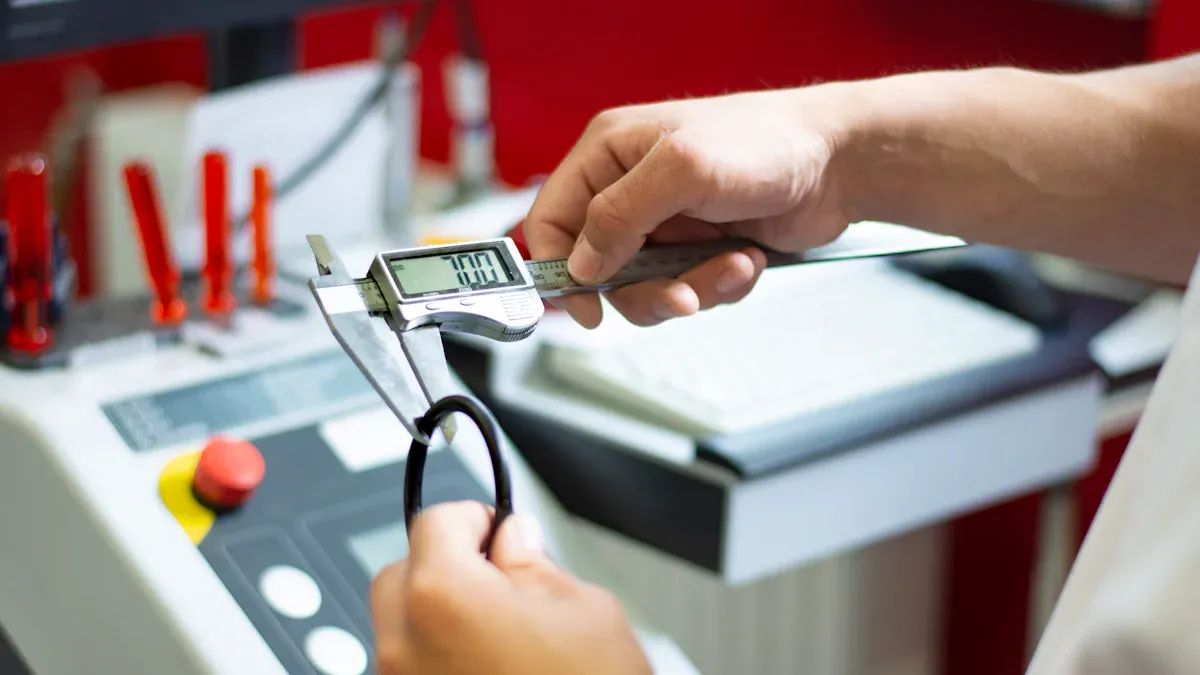
Thicker plates lower plane-strain fracture toughness ($K_{IC}$). Measure plate thickness carefully for vital flight parts.
Orientation | Plate Gauge Thickness (mm) | Plane-Strain Fracture Toughness ($K_{IC}$) (MPa√m) |
|---|---|---|
L-T (crack perpendicular to rolling) | 25–50 | 28–38 |
L-T (crack perpendicular to rolling) | 100–165 | 25–33 |
T-L (crack parallel to rolling) | 25–50 | 22–32 |
T-L (crack parallel to rolling) | 100–165 | 20–28 |
Thick parts drop metal toughness in all directions. Check gauge limits before finishing your plane designs.
Image Source: unsplash
Check real certificates before buying flight parts. Safety needs strict care.
Strict rules help your metal meet exact specs. Standard lists match primary rules with build guide:
Alloy Grade | Product Form | Governing Standard | Associated Aerospace Specifications / Practices |
|---|---|---|---|
Aerospace Wrought Products | General | ASTM B209 | ASTM B594 (Ultrasonic Inspection for Aerospace Applications) |
7075 | Aluminum Coil | ASTM B209 | AMS-QQ-A-250/12, AMS-QQ-A-250/24 |
2024 | Aluminum Plate / Coil / Strip | ASTM B209 | AMS-QQ-A-250 series equivalents |
Alclad 2024 | Aluminum Plate / Coil / Strip | ASTM B209 | AMS-QQ-A-250/5 |
Clear rules keep metal ingredients safe and uniform. You keep your parts from sudden breakages.
Inner gaps or cracks ruin an aerospace aluminum plate. Require Non-Destructive Testing (NDT) like ASTM B594 testing. Sound waves travel through your metal plate. Sound patterns spot hidden inner gaps. You find secret defects before cutting metal.
Tip: Ask for sound test proof on thick plates. This step stops sudden breakages in vital parts.
Heat care needs expert safety checks. NADCAP approval ensures top quality with easy steps:
Compliance with Prime Standards: Follow strict aircraft rules.
Rigorous Auditing: Pass ongoing safety checks.
Quality System Integration: Work with rules like AS9100.
Process & Equipment Control: Manage cooling and heating steps.
Mandatory Self-Auditing: Perform self-checks with ready lists.
Auxiliary Quality Measures: Add dye checks and tests.
Lastly, inspect your Material Test Report (MTR). Confirm these main details:
AMS Specification Conformance: Check for official rule passes.
Traceability and Markings: Match heat codes on paper and metal.
Chemical & PMI Analysis: Check precise chemical mix amounts.
Mechanical Properties: Review pull strength test numbers.
Authorized Certification: Require a signed safety paper.
Picking aerospace aluminum plate needs balance.
You must check strength.
Temper stability matters a lot.
Geometry needs checking too.
Check rules for full safety.
Talk to metal experts early.
This keeps your planes safe.
Use this checklist before buying:
Category | Key Requirement |
|---|---|
Material Selection | Pick good aluminum grade types. |
Dimensions | Check exact plate thickness levels. |
Quality Proof | Require clear MTR papers. |
Pick 7000 series plates like 7075 or 7050.
These metals handle very heavy physical loads easily.
They work great in top airplane wing skins.
T651 temper removes inner stress by pulling metal.
This simple step stops plate bending during cutting.
Your parts keep accurate shapes without twisting later.
You can shield high-copper plates in three ways:
Pure outer cladding metal layers
Anodized protective surface coats
Special protective rust primers
Tip: Always ask for sound wave test reports.
Sound waves find hidden inner gaps inside metal.
You catch secret defects before cutting complex parts.