

| Quantity: | |
|---|---|
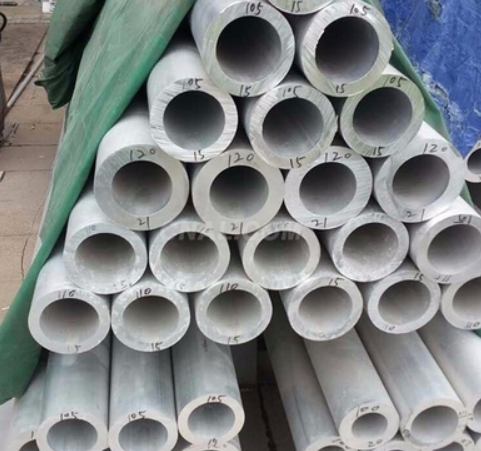
HSHALUC supplies aluminum alloy seamless tubes for applications requiring a combination of lightweight construction, mechanical strength, corrosion resistance and reliable tube integrity.
Unlike welded tubing, seamless aluminum tubes are produced without a longitudinal welded joint. This makes them suitable for demanding structural and fluid-handling applications where uniform tube construction and consistent performance are important.
Our available alloy range includes 2024, 2A12, 5052, 5083, 6061, 6063, 6082 and 7075, covering applications from aerospace and marine engineering to hydraulic systems, automotive structures and general industrial equipment.
Outside Diameter: 12–356 mm
Inside Diameter: 2–28 mm
Stock Length: 5–8 m
2xxx / 5xxx / 6xxx / 7xxx alloy options
O / T3 / T4 / T6 / H112 tempers available depending on alloy
High-strength and corrosion-resistant grades
Custom cutting and further processing available
Material and quality documentation available according to order requirements
Alloy / Temper | In-Stock Dimensions | Typical Mechanical Properties | Performance Characteristics | Applications |
|---|---|---|---|---|
2024-T3 | OD: 12–356 mm; ID: 2–28 mm; Length: 5–8 m | Tensile Strength ≥440 MPa; Yield Strength ≥290 MPa; Elongation ≥8–12% | High strength, good fatigue resistance, lightweight | Aerospace pipelines, aircraft structural tubes |
2A12-T4 | Tensile Strength ≥290–430 MPa; Yield Strength ≥245–275 MPa; Elongation ≥10–15% | High strength, good formability, commonly used domestic alloy grade | Aircraft structural parts, aerospace pipelines, mechanical structures | |
5052-H112 | Tensile Strength ≥190–215 MPa; Yield Strength ≥80–130 MPa; Elongation ≥10–15% | Corrosion resistant, good weldability and formability | Ships, automobiles, fuel pipes, general industrial piping | |
5052-O | Tensile Strength ≥170–195 MPa; Yield Strength ≥65–90 MPa; Elongation ≥20–25% | Soft temper, good ductility and formability, corrosion resistant | Bent tubes, complex formed tubes, fuel pipes, marine applications | |
5083-O | Tensile Strength ≥270 MPa; Yield Strength ≥125 MPa; Elongation ≥12–16% | Excellent seawater corrosion resistance and good weldability | Ships, yachts, offshore engineering pipelines | |
5083-H112 | Tensile Strength ≥275–315 MPa; Yield Strength ≥165–160 MPa; Elongation ≥10–15% | Higher strength than O temper, with good corrosion resistance | Ship structural components, offshore equipment, welded structures | |
6061-T6 | Tensile Strength ≥260 MPa; Yield Strength ≥240 MPa; Elongation ≥8–10% | Good balance of strength, corrosion resistance and machinability | Industrial piping, hydraulic tubes, automotive structural tubes | |
6063-T6 | Tensile Strength ≥205 MPa; Yield Strength ≥170 MPa; Elongation ≥8–12% | Good extrudability, high surface quality and corrosion resistance | Construction, equipment and lightweight structural tubes | |
6082-T6 | Tensile Strength ≥310 MPa; Yield Strength ≥260 MPa; Elongation ≥8–10% | High strength among 6xxx series alloys, good machinability | Ships and heavy-duty structural applications | |
7075-T6 | Tensile Strength ≥510–570 MPa; Yield Strength ≥430–500 MPa; Elongation ≥5–10% | Ultra-high strength with excellent strength-to-weight ratio | Aerospace and high-strength structural components |
The outstanding performance of aluminum alloy seamless tubes stems from their inherent weld-free structure combined with the superior properties of aluminum.
This is the fundamental advantage of seamless tubes. Welds, being material weak points, are prone to becoming initiation sites for fatigue cracks and corrosion. Seamless tubes completely eliminate this risk, enabling them to achieve longer service life and higher safety factors under dynamic pressure fluctuations (e.g., aircraft hydraulic systems) or prolonged vibration environments.
Through precise control of alloy composition and heat treatment processes, aluminum alloy seamless tubes achieve an optimal balance of strength, toughness and ductility. For instance, the 7075-T6 seamless tube, widely used in aerospace, has a tensile strength exceeding 500 MPa while maintaining sufficient elongation. Meanwhile, the 6061-T6 tube strikes a classic equilibrium between strength, corrosion resistance and processability, making it a staple in industrial applications.
The density of aluminum is only one-third that of steel. Under the premise of meeting equivalent strength and stiffness requirements, the use of aluminum alloy seamless tubes can achieve significant weight reduction. In the transportation sector, every kilogram of weight reduction translates to substantial energy savings and emission reductions.
The naturally formed dense oxide film on aluminum alloys provides a solid anti-corrosion foundation. The inner and outer surfaces of seamless tubes can achieve extremely high gloss through precision machining and treatment (e.g., anodizing), which not only reduces fluid resistance and prevents pollutant adhesion but also meets the ultra-clean environment requirements of industries such as semiconductors and medical applications.
This makes aluminum alloy seamless tubes ideal for applications such as thermal management systems (e.g., battery cooling plates in new energy vehicles), heat exchangers, and conductive busbars.
The birth of a high-quality aluminum alloy seamless tube is the deep combination of metallurgy and precision manufacturing technology.
2.1 Precision alloy design: Select appropriate alloy series based on end-use applications.
2 Series (Al-Cu-Mg) and special alloys: Designed for applications requiring heat resistance or specific performance characteristics.
3 Series (Al-Mn) : Such as 3003, are characterized by excellent formability and corrosion resistance, making them widely used in general engineering applications and heat exchangers.
5 Series (Al-Mg ): For example, 5052, with medium to high strength and seawater corrosion resistance, used in ships and vehicles.
6 Series (Al-Mg-Si): Including 6061 and 6082, can be strengthened through heat treatment and exhibit excellent overall performance, making them the most widely used industrial-grade seamless pipe material.
7 Series (Al-Zn-Mg-Cu ): Such as 7075, this ultra-high-strength alloy is designed for aerospace applications and other structures subjected to extreme stress.
2.2 Core forming process—hot extrusion perforation: This is the mainstream method for manufacturing large-diameter, thick-walled seamless tubes. A heated aluminum alloy ingot is extruded into a tube blank under immense pressure through a die equipped with perforation needles. This process requires extremely precise control of temperature, speed, and deformation to ensure uniform metal flow and dense microstructure.
2.3 Subsequent processing and heat treatment: The extruded pipe blank undergoes cold working processes such as drawing and rolling to achieve precise dimensional tolerances, higher surface finish, and strength. Subsequently, a heat treatment of "solution treatment + artificial aging" is applied to facilitate the optimal precipitation of alloy elements, thereby obtaining the desired mechanical properties.
2.4 End-to-end inspection and certification: Seamless tubes for high-end applications must undergo rigorous testing, including ultrasonic or eddy current testing for internal and surface defects, hydrostatic or pneumatic pressure tests to verify load-bearing capacity, metallographic analysis to examine microstructures, and comprehensive mechanical property testing. Products for aerospace, military, and related fields must also comply with specific standards such as AMS (American Materials Testing Society) and ASTM, while ensuring full-process traceability.
Project Requirement | Recommended Options to Consider |
|---|---|
High-strength aerospace tubing | 2024-T3 / 7075-T6 |
Aircraft structural tubes | 2024-T3 / 2A12-T4 |
Complex bending & forming | 5052-O |
Marine corrosion resistance | 5083-O / 5083-H112 |
Welded marine structures | 5083-H112 |
Hydraulic & industrial tubing | 6061-T6 |
Good surface quality & extrudability | 6063-T6 |
Higher-strength 6xxx structures | 6082-T6 |
Very high strength-to-weight requirements | 7075-T6 |
The correct material depends on more than strength alone. Working pressure, forming method, welding requirements, corrosion environment, dimensions, machining requirements and applicable standards should all be considered.
Send us your application, drawing, required dimensions and mechanical properties, and our team can help identify suitable material options.
Request Material Recommendation →
Aluminum alloy seamless pipes play an irreplaceable role in many high-end fields due to their unique advantages.
Application: Hydraulic system pipeline, fuel pipe, rocket engine duct.
Requirements: Extreme lightweight, ultra-high strength, stable performance across temperature ranges from-55°C to above +200°C and absolute reliability. Commonly used alloys include 7075 and 2024.
Application: Air conditioning tubes for fuel vehicles and electric vehicles, battery cooling system tubes, chassis structure tubes.
Requirements: Lightweight to enhance energy efficiency, good formability for complex layouts and resistance to corrosion by ethylene glycol-based coolants. 6061 and 6063 alloys are widely used.
Applications: Hydraulic and pneumatic system pipelines, heat exchanger tubes, vacuum chamber cavities.
Requirements: High-precision dimensional tolerances, excellent surface finish, good thermal conductivity or non-magnetic properties. Extremely high cleanliness is required.
Tell us your application, required dimensions, mechanical requirements and working environment. We can help you identify suitable alloy and temper options before quotation.


